The travel actions: what your photo needs to actually go somewhere
Hiking, surfing, a plane window, a scenery selfie. Unlike the landmark group, these actions keep the background you gave them rather than inventing a new one, which changes what the source photo has to get right.
Most of the action library either keeps a photograph exactly as it is and adds a movement, or discards the background outright and builds a new one, the way the landmark selfie actions send a photo taken in a living room to the Eiffel Tower. The travel group sits between those two. It keeps your background. A hiking trail, a stretch of coastline, open sky, whatever was actually behind you when the photo was taken, stays in the clip. That single difference changes what the source photo needs to get right, and it is the opposite of what the landmark guide tells you to expect.
It keeps your setting rather than inventing one
Hiking walks the subject along a trail under a loaded backpack, climbs onto a rock, and settles into a pause looking across a valley. Surfing carves a turn on a breaking wave and rides it back down the line. Both are built around outdoor movement through a real kind of place, and both extend and move the camera through whatever setting the source photo actually shows rather than replacing it with a generated one.
That matters because it inverts the advice that applies to the landmark group. There, a cluttered or ordinary background is a non-issue because it gets thrown away. Here, it is the opposite: your background is doing real work in the clip, and it has to survive a moving camera and a body in motion in front of it. A photo shot somewhere with genuine outdoor depth, a trail, a beach, open country, gives the model something to extend convincingly. A photo shot against a blank indoor wall gives it very little to work with, and the generated setting tends to look thin or inconsistent as a result.
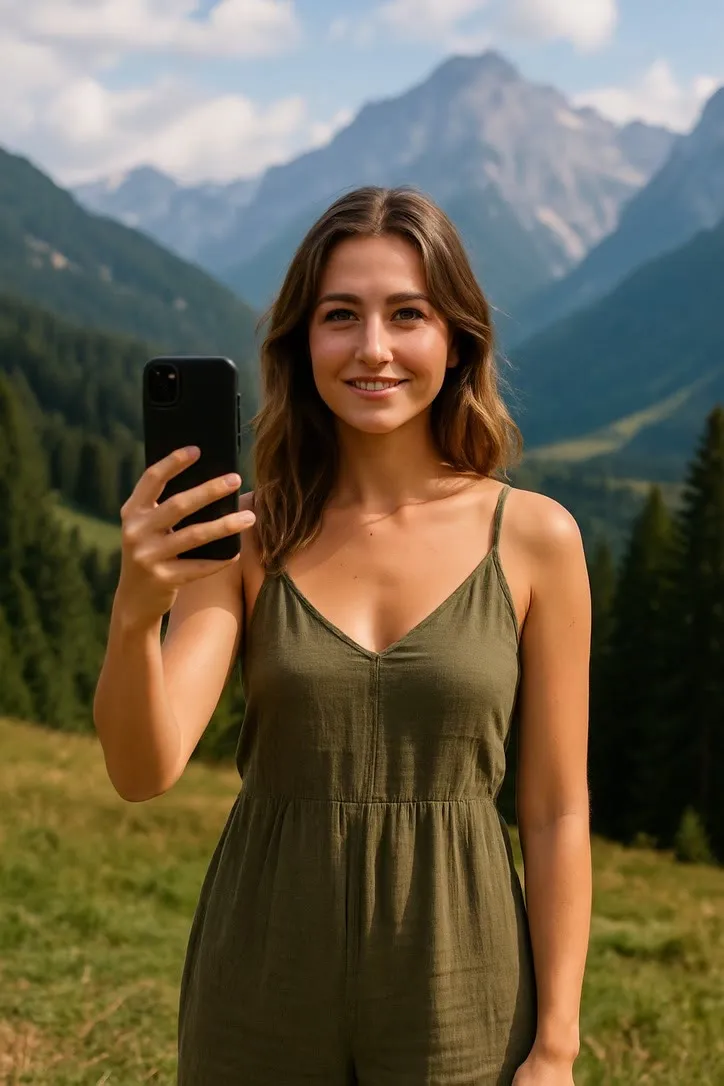
The same category also includes a plane window clip, which turns toward the camera from a window seat with clouds drifting past outside, and a scenery selfie, which holds a phone at arm’s length against an open landscape before lowering it to look at the view. Both behave the same way as hiking and surfing: they keep and extend the setting you give them rather than building one from nothing, so the same light and separation rules below apply.
Outdoor light is doing most of the work
This is the single biggest factor in how well a travel action turns out, more than the photo’s resolution or how recent it is. Outdoor light is usually bright and directional in a way indoor light rarely is, and that creates one recurring failure: backlight. A face shot with the sky, water, or a bright trail behind it loses detail fast, because the camera and your eye both expose for the brightest part of the frame, and the face is not it. The model is trying to carry that face across every frame of a five second clip, and a silhouette gives it almost nothing to keep faithful.
The fix is the same one that applies to outdoor photography generally: put the light source behind the camera, not behind the subject, or shoot at a time of day when it is softer and less directional, early or late rather than overhead. A trail photo taken with the sun at your back and the valley lit up in front of you is a far better starting point for Hiking than the same trail shot the other way around, even if the second photo looks more dramatic as a still image.
The second part of this is separation. The model still has to work out where the subject stops and the trail, wave, or sky starts, the same boundary problem that applies to any busy or detailed background. Outdoor settings are usually more forgiving than a patterned room because open sky and water are visually simple, but a subject wearing colours close to the surroundings, a green jacket against foliage, a navy wetsuit against deep water, still makes that boundary harder to hold.
Leave headroom, because the camera drifts
Every action in this group moves the camera, not just the subject. Hiking tracks alongside as the person climbs onto a rock. Surfing tracks above the water as the board carves a turn. The plane window clip pushes in slowly from the seat beside you, and the scenery selfie pulls back from the phone to the view. None of that camera movement is something you controlled in the original photograph, and all of it needs somewhere to go.
A tightly cropped photo, where the subject’s head is close to the top edge, gives a drifting camera nowhere to move without pushing the frame or cutting something off. A small amount of headroom, the kind you would leave in an ordinary outdoor portrait anyway, gives the clip room to breathe as the camera shifts. This is a smaller effect than lighting or background, but it is the one people notice least in the source photo and then see most clearly in the result, usually as a frame that feels slightly cramped for no obvious reason.
The photo this group actually needs
Put together, the travel actions ask for something closer to an ordinary outdoor photo than any kind of staged setup. A clear, front-on or near front-on shot of the face, outdoor light coming from in front rather than behind, a background with some real depth to it rather than a blank wall, and a little room above the head. None of that requires a dramatic location. A local park photographed with the sun at your back meets the brief as well as an actual mountain trail does, because what the model is extending is the kind of place in the photo, not the specific one.
One honest expectation worth stating plainly: the model has never seen the trail, the wave, or the view in your photo move, so what it produces is a plausible continuation built from one still frame, not a record of a hike or a surf session that happened. Treat the clip the way you would treat any of these actions, as a short, obviously generated illustration rather than footage, and it reads exactly as well as it should.
Said plainly
The travel group is the one corner of the library where your actual background matters as much as your face does, because nothing here replaces it. Get the light coming from the right direction, give the camera a little room to move, and a fairly ordinary outdoor photo does the rest. For the underlying crop and light rules that apply across the whole library, choosing a photo that will animate well covers the same ground in more general terms.
Common questions
- Do these actions work with a photo taken indoors, or does it need to already look like a travel photo?
- They work on any photo, but the result reads best when the setting in your source photo is at least plausible for the action: outdoors, or close to it. The model keeps your background rather than replacing it, so a hiking clip built from a photo taken in a hallway will still have a hallway in it, just one the model has tried to extend and move the camera through.
- How is this different from the landmark selfie actions?
- The landmark group discards your background entirely and builds a new one, so what was behind you in the original photo barely matters. The travel group keeps it. A hiking trail, a stretch of ocean or open sky you shot yourself survives into the clip and the model works with what is actually there, rather than inventing a scene from nothing.
- Why does backlight cause more trouble here than indoors?
- Because outdoor light is usually the brightest thing in the frame, and a face lit from behind it, say with a bright sky or open water behind the subject, loses detail fast. The model is trying to keep that face recognisable across every frame of the clip, and a silhouette gives it very little to work with.
- What photo works best for the plane window and scenery selfie actions?
- The same rules as the rest of the group: outdoor-strength light on the face if you can get it, clear separation from whatever is behind you, and some headroom since the camera in both of these drifts slightly rather than holding still. Neither needs you to already be on a plane or in front of a view. That part is built by the action.