The sports and fitness actions, and the one rule that runs through all ten
Jumping, running, boxing, a dunk, a spike, yoga and more live in two different catalogue categories, but they fail for the same reason more often than not: no room for the movement to land in.
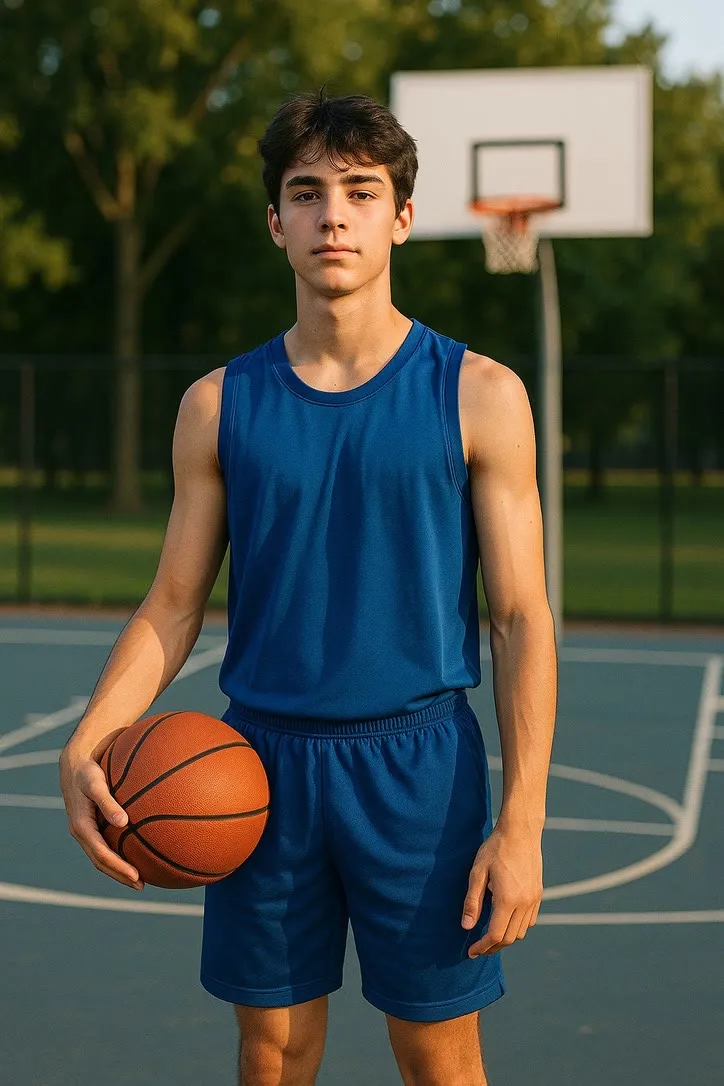
Ten presets live across two categories in the catalogue, Sports & Action and Fitness & Health. Jumping, running, boxing, the basketball dunk and the soccer goal celebration sit in the first. Yoga, weightlifting, jump rope, the volleyball spike and skateboarding sit in the second. They read as a loose grab bag of athletic poses, and most people pick between them based on which sport the person in the photo actually plays. That is the wrong first question. The right one is whether the photo leaves anywhere for the motion to go.
Leave space in the direction the movement travels
This is the single rule that explains more disappointing results in this corner of the library than anything about the sport itself. Jumping needs headroom above the subject, because the model is about to lift the body into that space and a photo cropped tight to the top of the head has nowhere to put it. Boxing needs room in front of the torso, because a punch travels forward and a photo where the frame edge sits an inch past the fist gives the jab nowhere to extend. Basketball Dunk needs space above and ahead of wherever the hoop ends up, because the whole preset is built around covering that distance.
It is the same underlying idea behind how much of the body a photo needs for the rest of the catalogue, just pointed at empty space instead of at limbs. A dance preset needs the feet in frame because the feet are what moves. A sports preset needs the air around the body in frame because that air is where the movement happens. Crop a photo tight around the subject the way you would for a nice portrait, and you have removed the one thing every action in this group actually needs.
What separates the sports cluster
Jumping, running, boxing, the dunk and the soccer goal celebration share a trait that sets them apart from the fitness side: they all cover distance or reach toward something. Running moves the whole body across the frame. The dunk reaches up and forward at once. Boxing throws a limb forward without moving the feet much at all. That matters for which photo to start from, because a standing portrait, arms at the sides, gives the model a believable starting pose for all five but asks it to invent the entire arc of movement from a single static moment. The less that arc has to travel through, the more convincing the result tends to be, which is part of why a punch, a shorter and more contained motion, tends to hold together better than a full sprint.
What separates the fitness cluster
Yoga, weightlifting, jump rope, the volleyball spike and skateboarding ask for something closer to a held position than a dash across the frame. A yoga pose settles into a shape and stays there. A rep of weightlifting is a short, repeated motion in roughly one spot. Jump rope keeps the feet near the same patch of floor the whole time. These are structurally the easier half of the ten, not because the sport looks gentler, but because the model is extending a position rather than inventing a journey. The volleyball spike and skateboarding are the two exceptions within this half, since both involve the body leaving the ground and travelling, which pulls them closer to the sports cluster’s harder end despite sitting in the fitness category on the catalogue page.
Arms away from the body
The second recurring problem has nothing to do with which category a preset sits in. It is what the arms are doing in the source photo. A swing, a throw, a reach and a punch all move an arm away from the torso at some point in the clip, and a photo where the arms are folded across the chest or pressed flat against the sides starts that motion from the worst possible place. The model has to separate the arm from the body before it can move it anywhere, which is a harder job than animating an arm that was already a little clear of the torso to begin with. It is a small thing to check in a source photo and an easy one to miss, because a relaxed, arms-folded stance is how a lot of people naturally stand for a casual picture.
Kit, equipment and gym mirrors
Background hazards show up more here than in a plain portrait action, for the same reason busy backgrounds break other animations: anything behind a moving body has to be tracked and rebuilt frame by frame. Gym settings are the repeat offender specifically for this category, because a weight rack, a mirror wall or a tangle of resistance bands gives the model a lot of fine detail to hold steady behind a body that is about to move. A plainer wall, an open floor, or an outdoor court with nothing crowding the frame tends to outperform an actual gym photo, which is not what most people expect walking in.
Said plainly
None of this is the model recovering footage of how someone actually jumps, punches or holds a pose. It is generating a short, plausible continuation from one still frame, and what it can plausibly continue depends on how much room that frame left it to work with. Pick the sport that matches the person, then check the frame for space in front of and above the body, and loosen any folded arms before you press generate. For the general version of the crop and space rules this category draws on, choosing a photo that will animate well covers the same ground across the rest of the library.
Common questions
- What is the one rule that applies to every sports and fitness action?
- Leave space in the direction the movement travels. A jump needs headroom above it, a punch needs room in front of it, a dunk needs room above and ahead of the hoop. A photo framed tight around the body gives the model nowhere to put the motion it has to invent, so it compresses or clips instead.
- Why do folded arms cause a problem in these actions specifically?
- Almost every preset in both categories moves an arm away from the torso at some point, a swing, a throw, a reach, a punch. If the arm starts folded or pressed against the body in the source photo, the model has to separate it from the torso before it can move it, which is a harder edit than starting from a photo where the arm was already clear.
- Does a gym photo work for the fitness actions?
- Often not as well as people expect. Gym mirrors, exposed equipment and weight racks in the background all give the model extra detail to track and distort once the body moves in front of them. A plainer wall or open floor behind you, even in a home or a park, tends to hold up better than an actual gym.
- Which of the ten is the easiest to get a good result from?
- Yoga and jump rope, because both keep the body closer to a fixed spot rather than travelling across the frame. Running, the dunk and the soccer goal celebration all involve covering ground or reaching toward something outside the body, which asks the model to invent more.